
The Official Uncorker of Ocean Bottles
Published in Issue #41The phone is not on silent as it usually is during the night. I wait for it to ring, hoping it won’t, hoping I’ll sleep through to morning. But at ten minutes to six when “Here Comes the Sun” charges out of its little aluminum body, I only need to lift myself out of a half-sleep to answer.
“Hello.”
“Simone.”
“Harold.”
“Simone.”
“When?”
“Two hours ago. We didn’t want to wake you.”
A swell of pain and I curl into myself, the phone hot against my ear.
“Simone.”
“Yes.”
“Natan went quietly. Didn’t suffer. They kept him on morphine.”
“Good.”
“Right before, before he stopped talking, he made me promise to take care of you and Lou.”
“Thank you, Harold.”
“You’re family, Simone, my sister, no different than if Nat were here.”
Harold starts crying.
I curl in tighter. My eyes and nose leak wet.
“When’s the funeral?”
“Tomorrow. Can’t believe your government closed the airport entirely. Damn this Covid.”
A wail tips out of me. I cover my face with the pillow. Lou sleeps in the next room.
“Simone?”
“I’m okay. It’s just. . . I want to come home for this and can’t.”
The word home reaches down through layers and years. Snowdrifts covering cars. Thanksgiving Day floats readied by the museum. Central Park. The Hudson. And more, and more. Home. Parents. I want my parents. I want my old neighborhood, its trees, its river, brick buildings, and concrete sidewalks. I want my old friends. And Zabar’s and bookstores with thousands of books in English.
“Simone, I’ve got to go. Lots of phone calls and arrangements.”
“You know Natan wanted to be buried here, in Tel Aviv. It’s not possible?”
“He did. It’s not. We checked. Only cargo flying into Israel. And even if the government agreed, they wouldn’t allow us in. I’m his brother, Simone, and my parents. . .”
“I understand.”
We both cry.
“We’ll Zoom the service and call you from the cemetery. So you can be there.”
I lie flat, hand on stomach, my body emptying. Not like a snake elegantly shedding skin. More like a slow torque crushing my insides to nothing. I close my eyes. Breaths are shallow. I need to get off the phone and into the bathroom.
“Thank you, Harold.”
“We love you, Simone. My parents want me to tell you especially, how much they love you and Lou.”
“We love you too.”
My lower stomach explodes. I close the phone and lunge towards the bathroom. Don’t know if I’m going to shit or throw up. I make it to the toilet and sit, head down, arms around knees. My nausea grows shallower. Tiles outline my feet. Seconds pass, maybe a minute. I stand slowly and from the tap bring cold water to my face.
The only good thing about cancer, really the only good thing, I stare at my greyish skin and red eyes in the mirror, is that it takes time to claim its prey. Time the sick person, family, friends, can use to prepare. If they are types who prepare.
Natan and I are.
Pregnant with Lou, I realized the value of the nine months of gestation. Time to prepare for the avalanche of change. Though you’re never really prepared. Cold water runs down my fingers like around streambed stones. Not for a baby. Not for death. When they finally arrive, the system is stunned.
I close the faucet and bury my face in a towel. None of this feels real even though I, we, knew this was coming. Knew it thirteen months ago when Natan got the spinal cancer diagnosis. Knew it six months ago when he went to New York for experimental treatment.
My body wants to collapse on the cold tile floor from the mass of grief, from having to live through my first day without Natan. Loss magnitude 9.0 Richter scale.
Who knew emotion weighed so much? But I can’t collapse. Because of Lou.
How am I going to tell her that her favorite man in the world, her father, just died? No Natan, we didn’t prepare enough.
I wrap myself in a terrycloth bathrobe. Six-thirty. Lou will be up around seven. In the kitchen, I move in slow motion, put two spoons of coffee into the press. I steady myself against the counter while the kettle boils water. The red light switches off and I push the button down again. Red light on. I want things to keep percolating.
Natan. I am broken and don’t understand. You’re not coming home. But ever since we met at our start-up company’s retreat, fifteen years ago, that’s a serious number, we’ve been “home” for each other. And had so much fun: clubs, dancing, beach parties, desert festivals, all sorts of substances, all kinds of men.
So much has changed since I asked you, Natan, my best friend—who anyhow declared we were “family”—for sperm. Three and a half years since Lou was born to us. Wonderful, ecstatic change that began when my fortieth birthday barreled its way towards me. I wanted a baby already and had no more patience to wait for a romantic partner. I asked you, you said yes, sure, if that would make me happy. And we became literally family. Our genes spiral together in Lou’s little body.
Too quickly the red light of the kettle switches off again and though I’m tempted to push it back down, I don’t. I pour hot water into the glass cylinder, stir the coffee grinds slowly with a chopstick, put the metal lid on, and wait for water to become coffee.
We had joked about having intercourse. In college, Natan had on occasion bedded women—a kind of double checking that he really wasn’t straight—but it would be too weird and not enjoyable (so what was the point). In the end it was easy enough for me to be artificially inseminated at the fertility clinic.
I look out the kitchen window. The sky has lightened. When did that happen?
Cassie and Rocco purr and wind themselves around my legs.
During Lou’s first year of life, Natan was in and out of the country so much he showed only a passing interest in her. Said he wanted to be known as “uncle” and took her for an occasional afternoon. But in her second year, he flew a lot less and fell completely in love with his child. This gladdened me to no end. Now Lou had an ima and an abba.
After that, no matter where he was in the world, Natan called to speak to Lou every day. When he was home in Tel Aviv, he wanted her at least half the time, though he agreed it was best she sleep in her own room and bed at my place. And many nights he stayed over to be there with her in the morning when she was warm like a roll fresh from the oven. He slept in my bed. We were used to it. So many trips to Sinai together. That one long adventure in Thailand. And the time a crazy ex-lover torched his apartment. Natan lived with me for the weeks it took to clean and renovate.
I stare into the smooth white porcelain kitchen sink and try to feel less. Press out the pain like wrinkles in a sheet. I remember the last time I was in New York, a year and a half ago—Lou was two—and Natan’s parents met us for the first time.
I slouch to the cabinet for a mug and place it slowly by the coffee maker. It was the first time because they were lukewarm about this entire arrangement. How could a gay man and a straight woman co-parent? Natan assured them we were far from the first and to just think of us as divorced (obligations and privileges spelled out) but better. We love each other. No history of heartbreak or loathing.
Whatever hesitations his parents had, they disappeared the moment they held Lou.
“I could kick myself for not flying over to be with her. I’m really sorry.”
Natan’s mother kept apologizing and I didn’t assure her that it was okay. She had ignored my invitations, and I could have used an extra pair of hands that first year when Natan was gone so much.
My parents, my mother especially, were ecstatic when I told them Natan and I were having a baby together. My mother came for the birth and stayed two months.
I watch the coffee make its way into the mug. As if someone else were pouring. I shuffle to the kitchen table. I can’t stand up anymore. The load’s too great. Sharp edges carve pockets inside me, flinging flesh right and left. I focus on my breath. In 2, 3, 4. Out 2, 3, 4. Even that hurts. I take a sip of coffee hoping for steadiness, but it only brings me back to Natan who taught me to wait until the water cooled a bit before pouring it over the grounds. Who showed me where to buy coffee in Carmel Market. Who bought me this fancy French press when the cheap one slipped from my hand one morning after a night of too much liquor and coke. Before Lou was even a notion in our lives.
I slide the mug to the middle of the table, not trusting my hands. They might lash out. Natan in hospice. The small juice cup on his tray during our last facetime call two days ago. Before the final strong doses of morphine. I looked at his small pale face on the screen and told him how much I loved him. And thanked him for Lou. The tears come. And come. I try not to make noise. Lou sleeps. I put my head in my hands and moan quietly. It’s not fair. Only forty-five. And brilliant, funny, loving, adventurous, generous, gorgeous, with a big dick he’s really proud of. And I get it. If I were a man and had a dick like that, I’d be proud too.
Soon after Natan was diagnosed with spinal cancer, and before the chemo, he set aside sperm. A few weeks later he asked me if I’d be willing to have another child. I was nervous. What if he got really sick and I had to deal with two children on my own? He said it would never be on my own. I would have enough money to hire as much help as needed. He looked so scared, so sad and desperate, I said yes. But also because I wanted another child. I was inseminated and the stars aligned as they had with Lou, and I was pregnant. We were thrilled. At forty-four, not to be taken for granted. Not at any age really. At eight weeks I miscarried. I had been very sick for about ten days, with flu we thought, high fever, cough, aches and pains, but only later, as the months of the pandemic dragged on, did I consider that maybe it was Covid. A colleague had come into work sick after a week in Seattle. In those early months, sick people weren’t tested for Covid. But I think now that it was that. My first fatality from the virus.
The second was Grandma Lily in a Connecticut nursing home, June 2020. So many old people died in those early months. She was ninety and frail and I made a point of calling her every week.
“Grandma, you’re a paragon of fortitude.”
“Bah.”
“A real role model.”
I thought about her passing as Christian in Bruges during the Second World War. All on her own. Everyone she knew gone or killed, many in front of her. And now keeping good cheer in a devastating pandemic.
She pushed back at compliments. She wanted to talk ideas, books. A big reader—what was I reading now, she wanted to know—she enjoyed clever vocabulary and liked my phrasing, “paragon of fortitude,” for its cleverness, not its meaning. She also loved English. Language of second chances. Grandma Lily, my father’s mother. Always warm but also a bit remote. Was this the residue of war? I loved her very much but didn’t fly home for the funeral, though during that period of the pandemic I could fly since I was both an Israeli and American citizen. But I didn’t want to expose myself, and so Lou and Natan, to the virus. Enough was going on. Grandma Lily’s was my first Zoom funeral.
Suddenly, “Here Comes the Sun” plays. I bang my hand on the phone to stop it. Lou sleeps. I see it’s the division administrator from work. I don’t answer.
Ever since Natan went to New York for treatment, my ringtones have been different George Harrison songs. Helps me feel connected to him. He’s a Harrison freak. Lou especially loves “Something” and these past couple of weeks I’ve been sending Natan clips of her dancing to it.
Last week when he called, he told Lou she was the most glorious three-and-a-half-year-old dancer he’s ever known. “Something in the way she moves,” he laughed, and she laughed too, and started waving her body all over the room, the phone spinning in her small hand. And when she paused, Natan continued, “Something in her smile she knows.” And he smiled and Lou smiled and then he sang softly, “I don’t want to leave her now, you know I believe and how.”
Then Lou handed me the phone.
“Abba’s crying.”
He waved goodbye. Exhausted from it all.
“Bye for now,” I whispered to him. Lou wanted the phone back.
“I want to talk to him. I want to dance for him.”
“Lou please.”
She tried to grab the phone from my hand. “Want to.” She raised her voice.
“Abba’s not feeling well. He went to rest.”
“But I want to dance for him.”
And she fell to the floor crying. More than anything I wanted to give her what she wanted. More than the phone, more than the dance, her father here, holding her, loving her. Cassie closed in on the child and Lou sank her face into his white fur and cried some more.
My body shakes with pain and suddenly a small hand flutters like a butterfly on my hair. I look up. Lou with that wild glorious smile she got from Natan. She climbs onto my lap. Puts a leg on either side of my hips and wraps her small arms around me.
“Don’t cry, Ima.”
She sings to me. “Don’t worry. It’ll be all right.”
She sings some more and pulls back enough for her little finger to trace the outline of my face. Her eyes lock onto mine.
“Don’t cry. Everything, hmm, all right.” Her serenade overwhelms me. I melt into her eyes, into her touch. She continues. Now both small hands caress my head, my hair, my face.
“Don’t cry. I don’t want to leave her now. You know I believe and how.”
She leans against my chest, her arms wrap me tightly. I close my eyes and can’t not cry. I am as moved by her as I am agonized by Natan.
“Shh, Ima. Shh.”
I hold on to her small back and open my eyes. Sitting on the floor not more than two feet away are Cassie and Rocco. Like Lou, they know something’s wrong and have come to comfort me. They watch and wait for their moment to approach.
*
After the funeral I change the ringtone to “Give Me Love (Give Me Peace on Earth).” Lou adores it and mumbles through the words whenever someone calls. Which is a lot these past few days. This is my first shiva and I don’t like it, don’t want it, and am grateful few people feel defiant enough to flout the one-kilometer dog leash around our necks to come to my apartment to comfort me. Also, it’s been storming on and off for days. Still, it’s tiring to talk to those who do come and to those who call. I have nothing to say. The only person I want to talk to is Lou. And we sing more than talk.
This morning, four days in, the sun’s come out, and I’ve had enough. I handwrite a sign in Hebrew and English that the shiva is over and tape it to my door. I tell Lou we’re going to the beach. Natan and I love the Mediterranean. Never gets old, he would say every time we went.
Hand in hand, Lou and I walk on the sand. The water is rough and dangerous from the storms. Beautiful too. Crashing loud. Black, white, and dark green roil in the swells. I take off the face mask. After so much sickness, after so many weeks home, working, isolating, pacing, feeling the walls, it’s good to be in salt-saturated sea air. Just what the wreck of me needs.
Heaps of seaweed and bits of garbage kicked up from the strong currents cover the beachfront. The sky is a grand blue. Not a cloud. And the unobstructed sun makes it warm for early February. The wind also has died down. I want to sit for a while and gorge myself on nature denied for so long.
Lou searches for treasures and finds a toy replica of a cement mixer.
“Ima.”
“Don’t touch plastic bags.” I call out. “And nothing made from metal. And no dead fish.”
I, we, have become hypervigilant about touch. Where hands go, what they do. How much we learn through them, because of them. And how they’re also double agents.
I stand a couple of meters from the water line. One eye on the child. The other imagines me swimming past the wave breakers to Cyprus or Egypt. Or possibly even further. I was once a strong swimmer. Maybe I could make it to Greece or even Italy. I want to escape this government’s Levantine ghetto.
Suddenly a very loud engine pierces the scene. I turn for a moment. A policeman on a motorcycle is on his way to me. I am calm. I know the restrictions well. Too well. I’ve been obsessively reading them for weeks now, waiting for a change of policy, for the airport to open so I could fly to Natan.
I turn to see Lou dancing among the mounds of seaweed like a nymph, or maybe just like an ordinary three-year-old happy to be out of the house and in the air and near the water a year into the pandemic.
“Leave the beach.” The policeman barks. Reluctantly, I turn again.
He’s in black leather: pants, boots, jacket. On top of the mandatory Covid mask, sunglasses, helmet visor down. His entire face, his eyes, are not visible. Darth Vader of Gordon Beach.
“We’re within the mobility rules. Children are allowed to play outside.”
“Not at the beach.”
“I live less than a kilometer from here. We walked here. That’s exercise. That’s allowed at the beach. What’s the difference between being here and the playground?”
“You have two minutes.”
A quick check on Lou. She plays with her cement mixer in the sand.
“Plenty of space and air here. No threat of the virus spreading.”
“One minute.”
There is menace in his voice. His motorcycle growls loudly, snug between his legs. My mind thinks Gestapo. Yes, I horrify myself with this thought, but there it is.
The cruel cold practiced voice ordering women and children to move.
“You should be ashamed. Chasing us from the beach.”
“I’ve wasted enough time. Get your stuff and go before I give you a fine.”
“Give me a fine.” Now I’m angry. “I don’t care.”
I am sick of power-hungry people like him. First they seized the streets, now the skies. Loving each centimeter they occupy. Pleasuring themselves while we squirm.
“Or maybe you’d prefer to hit me first like at the demonstrations. Anti-Bibi types like me. Go on, give me a fine.”
I turn my back to him. Too overwhelmed by everything to be nervous. Unlikely he’ll hit me with my child so close and people already filming us on their phones in case he does.
The motorcycle retreats. Not sure why and I don’t care. He and the rest of them can go to hell.
Facing the water, atavistic fears emerge. A visceral memory of a war I didn’t live through surges in me as the waves beckon and retreat. I see myself swimming farther now. Out of the Mediterranean and into the Atlantic. I reach New York Harbor. Past Ellis Island, the Statue of Liberty, and up the Hudson. I climb out at the Boat Basin, wobble up Riverside on sea legs to my parents a few blocks away. Lou strapped on my back, a watertight papoose.
Cormorants bring me back. To here. To now. A large V formation overhead, necks stretched south to Africa. I want to swim. I want to fly. The loneliness of being on the cusp of continents and cast so far away from where Natan was just buried. Where my parents and his parents live. Except for Lou, where everyone I most need is.
I think of Grandma Lily, and thousands like her, alone in hospitals, without touch, everyone scared, no one they know or love allowed to approach. Cared for entirely by dedicated strangers in hazmat suits. The sick clinging to the eyes above the masks behind the shields. To the humanity in the gaze. And despite all good intentions, the grave chill that embraces them long before death arrives.
The cormorants move quickly. It is a beautiful day and I am grateful for it. I want to be only here now but can’t stop thoughts about government trespass.
Lockdown. Phone surveillance. Police patrolling streets and beaches. Movements tracked. Skills honed on Palestinians for decades moved seamlessly to the western side of the Green Line.
Lou pulls at my elbow and hands me a small dark blue bottle. It looks like it’s been at sea for a long time.
“Something’s in it.”
I turn the bottle round. She’s right. There’s paper in it.
Lou takes the bottle back and starts pulling at a wax-like sheath. With her little fingers she isn’t getting very far.
“It’s a message in a bottle, Lou.”
“I know. It’s from Abba. It’s like in the book. Children throw the bottle in the water and their parents find them.”
She’s got it all figured out and hands me back the bottle. I sit down on the sand and pick away at the wax.
“In England hundreds of years ago, there was a person called the Official Uncorker of Ocean Bottles.”
“That’s me. Official Coco of Bottles.”
I laugh a little.
“Yes, that’s you. The queen said only this person could open bottles found at the beach.”
“Why?”
“Cause secret messages were sent that way. Secrets only the queen could know.”
“But we’re allowed Ima cause it’s Abba’s secret message.”
“Exactly.”
She sits down and leans against me. Underneath the wax there’s a cork. Luckily a Swiss Army Knife is in the beach bag. I work the short metal spiral into the cork and pull gently. It pops out loudly.
“Wow,” we cry in unison and I tilt the bottle and a small, yellowed square of paper slides out. One side is blank. A faint outline of a heart is on the other.
Lou takes the paper and holds it to her heart. She spins around me.
“Give me love, give me love, give me peace on earth.”
I blubber with tears and anguish. Lou sings louder.
“Give me hope, help me hope. Something in the way she moves.”
She whoops and whirls and then carefully places the blue bottle, the cement mixer, and the yellowed paper down on the sand.
“Abba told me to tell you that he’s part of the waves and come summer, he’ll be hugging you every time you’re in the water.”
“I know.”
She sings. And catches my hands to pull me up to dance. I move slowly then gradually faster. My fingers braid with hers. We go round and round. Lou leans back, her face flat up to the sun, and my heart, my heart is buoyed by a love that eclipses the many surrogates of pain.
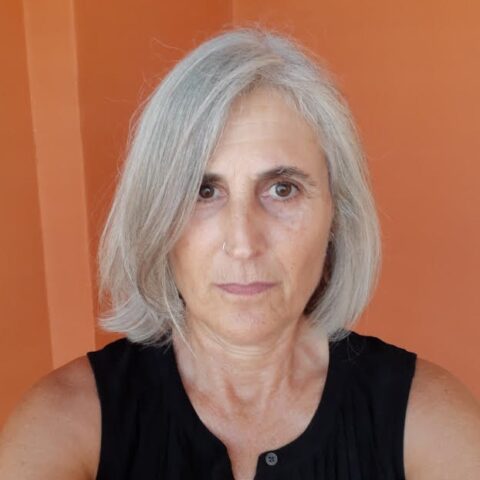
The Author
Copyright © Miryam Sivan 2025