
Celebrating Purim / Hasan’s Vineyard
Published in Issue #42 Translated from Serbian by John K. CoxThe Purim celebration was held in the large hall of the Jewish community center. A hundred men and women, mostly middle-aged, with just a few children and older folks, sat at tables set up in two rows, from which a busy hum of conversation arose. Several women carried around trays of little hamantaschen, decorated with apricot jam or powdered sugar. They waited by the door for the opening speech to be over.
“Dear comrades and friends,” said the president of the association, standing near the stage that was almost entirely occupied by a piano. “I am happy that we once again have the opportunity to celebrate the accomplishments of brave Esther and wise Mordechai, who prevented the extermination of their people, at that time scattered throughout Persia, and who sternly punished their enemies. I cannot, however, on this joyous day, gloss over the fact that my heart is heavy with grief, because there should be ten times as many of us here rejoicing at Purim.”
Oskar Rot, lean and boney, the only one of the men wearing a sports sweater, looked in wonder at the little man whose voice shook just like the paper he was holding up to his short-sighted eyes. After ten years of roaming around the world, and especially after the years he had spent in Israel, Oskar had just grasped that the world, the farther a man flees, shrinks and narrows all the more; and at the conclusion of the hundreds and thousands of kilometers run in constant flight from the enemy, and from oneself, there stands a trembling little man like this one, with his ten or so listeners who believe that the story they are hearing is still happening. He had the impression he was watching a colorful cinematic spectacle in some small, desolate provincial movie theater.
“The Jews then killed tens of thousands of their enemies and drove fear into the hearts of the entire realm,” the president continued. “But from that point in time till today, over these two thousand-plus years, Jews have endured far more fear than they have instilled in others. If anyone has a reason to fear Jews, it is above all Jews themselves.”
Olga Belić giggled loudly but tentatively. Her large body kept scooting up on the chair next to Oskar’s, and little by little it crept into his field of vision, where it remained. She was now eighteen years older, and at least that many kilos heavier, than the last time he’d seen her, but those years and kilograms did not come across as excess but rather as a disconcerting deficit of something: it was a lack of youth and of lightness. Back then, on the occasion of their last meeting, at a Purim party before the war, Olga was robust but slender, and her self-confidence, that certainty of a young seductive woman, a defiant certainty despite all the bad presentiments, filled the whole hall of the former cultural center. The emptiness that remained behind all that lack filled only her body. Her body was superfluous, heavy, tired, and impeded, with deposits that had settled under her skin like loose tissue, smothering and leaving her tired and heavy and yet despite everything somehow intimate and attractive.
“I will take the liberty of saying something about the Jewish cause,” said the master of ceremonies, a gaunt young man with tiny, sleepy eyes and a big clown-like mouth. “As you might know, after two thousand years the presidency of the Jewish community of Novi Sad has finally won the ultimate victory over antisemitism. On the basis of its official complaint against members of the Roma orchestra that played antisemitic songs on New Year’s Eve in a café in Subotica, the district court there has sentenced the first violinist to four months, and the other members of the ensemble to three months of jail each.” The audience smiled vaguely. At the back of the hall weak applause could be heard. “And now allow me to announce our dear guest, the opera diva Emilija Atanasovska, who to a piano accompaniment by our irreplaceable Lidija Poper will sing arias from Bizet’s opera Carmen, in which our guest is playing the character of an enchanting and mysterious Rom—” and here the emcee had to bite his tongue. He had a grim look on his face. “Well, I’ll be. As soon as you want to say something about fervor and unhappiness, you run into Jews and Roma!”
The prima donna was a beautiful, buxom young woman, smiling radiantly from head to toe. Her mouth, cheeks, double chin, breasts, and stomach evoked, at various heights, the cheerful curve of her wide smile. While she was still passing through the rows of seats, one could see that she was waving and smiling too broadly for this cramped space; and when she climbed up onto the stage and let loose her powerful mezzosoprano, it became obvious that the untuned, asthmatic piano, no matter how its lid gaped or how many chords the diligent pianist struck, could not subdue, reduce to the desired scale, the provocative vitality of her voice. Likewise the assembled members of the Jewish community, however much they opened their hungry and wary senses, could not take in all of its devastating health. It felt as though there were some kind of misunderstanding at work here, that Atanasovska, with the indolence of a diva, had turned up with an impermissible delay of twelve or fifteen years, and that the enthusiastic buzz of the audience was only an external expression of deep internal uneasiness. And when Atanasovska finally sent several fiery kisses out towards the public, firing them from behind a cloth flower she had just pulled from the low neckline of her green satin dress, Oskar Rot leaned towards Olga Belić. Not encountering any opposition from her bulky emptiness, which was devoid of the effectiveness of youth, he glided with Bizet’s music down the fatal slope of Olga’s upper arm and confidentially and fervently squeezed her wrist.
“Do you know how to harvest cotton with both hands?” Blum asked. “The Albanians were looking for urgent help with their food situation from the Soviet Union, because after droughts in the summer, they had a famine there. The Russians didn’t send food, but they sent several thousand copies of a manual called How To Harvest Cotton With Both Hands. That’s not a Jewish joke—it’s an American one.”
“I prefer American aid,” Olga said. Hesitantly, she withdrew her hand.
“So, Oskar, you came back?” asked the president of the Jewish community, offering his hand across the table and over the hunched figure of the elderly Ruža Adler.
The Jews who, in their day, hadn’t had the courage to emigrate to Israel were now readier than the others to hold it against Oskar that he betrayed their own dreams of the Promised Land, but secretly they were grateful to him for confirming with his return that their caution and fear of the difficult life and uncertainty in that new state, surrounded by deserts and Arabs, had been justified.
“We’re going to marry off Olga in Jerusalem,” Mrs. Adler said, as she used her long, gaunt fingers like a beak to gather up all the grains of sugar on her little plate. Since liberation, she had made all kinds of matches between widows and widowers, some of them returnees from the camps, as well as those whose late, delayed reactions to the traumas of war played out in the groundless severing of longstanding marital bonds. “The Russians will force all the others into some marriage or other.”
“Some marriage or other,” exclaimed Erna, feeling her daughter’s eyes on her. She was standing on the other side of the hall, listening patiently and absent-mindedly to Sara Hofman, tongue-tied and flustered, who had been telling her and Erna in great detail half an hour earlier about her visit to old Mrs. Adler, and about her unfortunate three-legged dog who, separated from the canine world by the walls of the courtyard, and three-legged, shook and groaned on the mat by the kitchen door. And when Oskar takes a woman’s overcoat from the hangar and holds it out to Olga Belić, Mima Bader breaks off a conversation she was having and addresses her uncle in a loud voice: “Where are you off to, Uncle?” “To see Mrs. Belić home,” Oskar answered. “See you later.” Olga Belić, feeling herself a bit on the spot, said to Oskar: “I really love that little girl.” And then, taking a step closer to her ear, added, with a painfully credulous smile of unspoken understanding, “I remember when you were born.” Mima Bader responded with a fake smile. For her this recurring little kindness from Mrs. Belić was only further confirmation that the story of her birth concealed some kind of trouble, while the regularly confused Olga Belić was eager to offer more than she could deliver. Because Olga got closer, with this sentence, to everyone and everything, including her own disavowed origins, faster and more pointedly than was appropriate in a matter like this, the sentence was meant to replace and, if possible, render painless an image from Dunavski Park at the beginning of the summer of 1938, a scene in which she, Olga, was out by herself with six-month-old Danijel in a stroller, next to the pond that reflected the fresh, green crowns of trees, and she promised her son to the rosy-faced two-month-old infant Mima Bader, whose face was shaded by a lace cap and who, despite the jolting ride in the stroller and the conversation of the parents and the bustle of children around them, was sleeping peacefully in the mild June sun.
Oskar Rot waited for her in the open door, which was letting in the cold from the unheated hallway. The ponderous Sara Hofman set her stocky legs into motion and tugged at Mima Bader, like in an English waltz, spinning down the aisle between two long tables. Olga, suddenly afraid that she was missing out on something important, nearly shouted at Mima, who was resisting Sara’s pushiness, “Are you going to fall in love with my Nenad?”
By the time they were heading down the dark stairs of the building that housed the Jewish association’s offices on its second floor, Oskar had energetically clasped Olga’s shoulders, not so much to pull her towards him but rather to push and pull her somewhere, so that without a word he was conveying her down the street named after the Yugoslav People’s Army, and when he, with an unexpected intuition for ugly entranceways—for he barely remembered this street, and a few of the facades, but the courtyards not at all—turned into the doorway of a house farther down in the direction of the marketplace, into the sullen blackness of a courtyard in the middle of which he could just make out a pool of water, from melted snow and a malfunctioning drainage system, and, assailed by the stink of a nearby outhouse and a short anxious neigh from an animal off to one side, he, still without saying a word, pressed the large woman up against the wall, a fence actually, unbuttoned her coat, lifted her skirt, removed her underwear, unbuttoned her garters and pulled her corset upwards so it wouldn’t be in the way, and then, seeing now that her knees were exposed, he pulled the woman away from the wall, firmly groped her buttocks, and began pounding away at her.
When he separated from her, he carefully leaned her against the wall and offered her his handkerchief. “I’ve got one of my own,” the woman said, but she couldn’t find it in her purse. “Take mine,” Oskar said. He wanted to wipe away the traces of his sudden fury, his senseless desire for revenge, the origins of which were not clear to him. He had again for a few moments knocked on the door of this place that he hated, and to which he always returned. He did not even know it well, and he was sick and tired of it. So with his handkerchief he wiped the woman off between her legs, with an unexpected tenderness as if he were wiping her eyes and cheeks, feeling sympathy and tenderness for her like for some inexperienced girl who didn’t grasp what had befallen her and was even happy that he had successfully had his way with her like that, standing, like a thug, in that damp smelly courtyard, the way young hooligans do it when they jump some girl’s bones by a barn, or as students do, in a pinch, when the grass is wet and the ground bumpy. Olga walked awkwardly, as if she were still squeezing the cloth between her legs. She was properly put together again, except that her little brown felt hat was out of place. Oskar strode along with his hands in his pockets. It seemed he had lost one of his gloves in the courtyard. Custom now dictated that he put his arm around this woman, or hug her protectively, but his heart wasn’t in it. She walked next to him, her head turned a bit to the side, not because she was defeated but because one of her ears was pricked up (it was probably the rim of her little hat that accounted for this impression) and Oskar felt the nausea of her expectation:
“Do you want to know why I came back?”
His voice was deceptive but promising. It was a voice that lures you out onto thin ice and then metes out punishment.
Olga sighed, as if, despite all of her painful experiences, she nevertheless wanted to trust that encouraging voice behind which she could feel a hint of deception. She took off one of her knit gloves and gently, forgivingly, caressed the man who had once composed a love poem to her in school, and, after many years, mailed her a letter from one of his wanderings in his lackadaisical handwriting in which he apologized, pointlessly, for his youthful indecency.
“Because I killed a man there.”
Hasan’s Vineyard
He told the story to anybody who’d listen.
He explained that they had lived in a hamlet in the hills of Judea, not far from Jerusalem, in a small house surrounded by a high stone wall; the sun made its way into the house only through the grates on the small windows. It was a house that an Arab family had abandoned after the war of 1948, leaving behind lizards, centipedes, snakes, and rats. He described his friendship with a black snake that was two meters long, a so-called domesticated animal that was improbably adroit at hunting mice and rats, and that would hurl itself with a powerful movement, from behind a wall, or in the pantry or the kitchen, onto disgusting rodents in the quiet of the afternoon, while the family was resting, and especially at night; it wantonly knocked over tin cans and plastic jars as well as wooden baskets and clay pots, along with their contents of potatoes and onions, with its tail.
Her name was Lili, although we never knew if she was male or female. My parents named her after Lilith, the demon, although she was a good and useful animal. At night she played around like crazy. If one of my parents popped into the kitchen, Lili would slip away; she didn’t want anyone to see her. Only I knew what she looked like; she let me see her and I did see her. With my own eyes I watched as she mesmerized a gigantic rat and flew at it, and the rat voluntarily crawled into the snake’s jaws like a hand into a glove. My father hated her, because she wouldn’t let him sleep, but my mother didn’t let him lay a hand on her. Lili was the guardian of the household, like a pot of sempervivum. From the story of the snake, the traveler switched to a description of the infernal summer heat amidst the bare stone hills where you had to pull the rocks from the soil by hand, thereby creating a garden where you could then plant produce to sell, and then he shifted to tales of raising poultry and teaching in a Jewish school there, where people learned as much as they wanted and listened to the teacher only when they were dying of boredom, and then he moved on from telling about this heavenly school to relating the dangers and challenges of the life there, the shots fired in the middle of the night from the other side of the border, talking about the Arab Legionaries who attacked Israeli villages at night and killed the guards, and about Israeli commandos.
From the transit camp in Beersheba, he said, we moved into an Arab village on the Jordanian border. We got some vineyards. We had just moved into the village, and all around were abandoned fields, but the vineyards were a bit farther away. My neighbor Majmonid Šmuel and I started tilling the soil. The ground was thin and worn out, but we worked at it and things looked promising. And then one day down the hill came an old Arab. Actually we caught sight first of his gaunt donkey that was trying to cross the nearby orchard. Then we spotted the old man. He was jumping up and down and cutting branches with a pair of shears. He might have been around sixty years old. His hair was gray and thinning, and his face bore deep scars. Ragged clothes. Barefoot. Just like the thousands of refugees who tried to make their way back after the war of 1948. We pointed our guns at him, but he didn’t even blink. He kept working. We asked him what he was doing there. He said he was working in the vineyard. As if there hadn’t been any war, or all those bodies. Šmuel repeated the question; the old man repeated his answer. Only this time he said, “in my vineyard.” What else was a peasant supposed to do other than cultivate his vineyard? What did the war matter to him? It was a fairly small vineyard, with a few palm trees and figs, but it was well kept, free of weeds. That was rather unusual. In that first year following the war, an Arab tending to his field in enemy territory, without considering that it might cost him his life. . .
We blindfolded him and took him to the commander. He said his name was Hasan and told us what family he was from and which village. He said that there, on the other side of the border, there was nothing to tend and nothing to eat, so he had come to work his property on this side. In the police station he added nothing new to this, but he wondered out loud about why it was now forbidden for a peasant to tend his vineyard. The policemen thought he was crazy, and they wanted to lock him up. They gave him some work in the courtyard of the police station, and he puttered around there until one night he disappeared. For a while we didn’t see him. The rains came, and we didn’t go out to the fields, but when the weather improved, we did. Once again there he was—Hasan. With a stick across his shoulders and a sack in his hand. Right in front of us. He pulled some oranges out of his sack and offered them to us. We declined. He didn’t react, just kind of smacked his lips as if to say, “Have it your way,” and he went out to the orchard to work. We set out after him again, to explain to him that he now lives on the other side of the border and he wasn’t allowed to come here and just hang out any time he felt like it. But he didn’t seem to get it. We led him to the border and pushed him back across. The next day—there he was again, in the orchard.
He was dragging over some tin containers and trying to build a hut. Šmuel and I yelled at him: what is this supposed to be? And he replied: he was making a little house for himself on this side of the border. What could we do? He seemed completely convinced that he was in the right. But if we allowed him to stay, he might collude with the Arab infiltrators. Others believed he would be careful and would keep his distance from them. We all shrank from the precedent: if we permit him to do this, what will we do with the other refugees?
We hoped the situation would resolve itself. Hasan finished working at noon, stowed his tools in his tin shack, and then invited us in. To visit his new house, as he put it. He offered us seats, presented us with some black cake and a few almonds and figs. My friends had no idea how to behave; I accepted what was offered. The others did the same. And so Hasan remained in that little house.
Around the hut vegetables came up; he sowed wheat and pruned the trees and vines. On Saturdays we would pass by there and stop in at his tin shack. We sat down on the planks, floundering in Arabic, conversing about the harvest and the rain and whatnot. He usually addressed me, as if he trusted me the most, and he talked to me about serious things. Once, as proud as he could be, he told me that he had planted French seedlings in his village, and while the grapes in other vineyards had been green and puny, his were dark red, sweet, and juicy. On another occasion, he told me about his life. His father had been a Bedouin and had been settled here during Ottoman times. But Hasan was already a true fellah. His sons worked, once upon a time, for the British, and he’d arranged a lucrative marriage for his daughter, as he put it. But when his wife died, in the years when the British were still here, and his sons perished in the “war against the Jews,” he remained alone. And since over there wasn’t, again in his words, even enough for a dog to eat, he came back here, to his house. (Alhamdulillah!)
Not long afterwards, the activities of infiltrators in our area increased. They tried twice, unsuccessfully, to make it all the way onto our moshav; the third time they managed to snatch two cows. We were beside ourselves with rage. Some people suggested that we go across the border and look for our cows in the closest village, and along the way teach the Arabs a lesson. But other people were more restrained, and they reminded us that there were United Nations observers on the other side. That was when most of our rage for vengeance descended on Hasan.
In the semi-darkness I went out to Hasan’s vineyard, yanked the hoe out of his hands, and said: “Go on! Get lost!” He didn’t balk or even seem taken aback. “I need that hoe,” he stated. I said: “Hurry!” But I waited until he had stuffed the items he wanted into his bag. He picked up a piece of cake from the bench, as if it were the same one he had shared pieces of long ago, and he got the clay pot with the one broken-off handle. “It’s over!” I said, and I raised my rifle and put a hole in the tin. Two holes: the bullet passed through two opposite walls, and the setting sun squeezed a reddish ribbon into them. They were the kind of strips of light that intersect at a festive opening of some new building. But this was a closing. Out of the corner of my eye, I noticed Hasan’s huge shears hanging from a nail.
I waited till he crossed the border and then I went back and put two more bullets through the sheet metal. The house still contained some rags, a broken saw, and, under the bench, a mallet made of a round log and a gnarled handle strapped in place with a piece of leather. I picked up the mallet and swung it around as hard as I could. The wall sagged and tilted, but the shanty remained standing. What that magpie of a man had cobbled together out of old tin, I couldn’t bring down with my eighty-five kilograms of weight. With the butt of my gun, I knocked off the roof, and then I hurled my full body weight against the walls till I toppled them. When they collapsed, they turned out to be just sheet metal and patches of tin after all. I gathered them up and hauled them to a corner of the vineyard and tossed them into the brambles. On the place where the shanty had stood, there was only trampled earth and some withered weeds. Like a shattered and scattered nest.
That summer there was a good crop of fruit. At four in the morning we would go out into the vineyard; later, when the sun’s heat grew unbearable, we carried the grapes into huts and packed them. At night we feared that the enemy would destroy our work. The harvest cheers people up and dazes them, too—weakening their vigilance—and the enemy knows how to capitalize on that. One evening it was my turn to keep watch. A hot, overpowering wind had started to blow, the kind that gives you a splitting headache and leaves your lungs as weak and useless as rags.
The whole afternoon I didn’t close my eyes. I went on guard duty afraid of falling asleep. Therefore I put twice as much effort as usual into the preparation of my blind. When I had dragged together enough branches and sticks and settled in behind them, I realized that my blind looked right out over Hasan’s vineyard. It was still in tip-top shape, although we had turned our backs on it a long time ago, probably because the memory of Hasan took away our desire to work there. The dried leaves had been scraped into piles, and fat grapes glinted from afar as if each one of them had been carefully polished. I shuddered like a man who discovers a well-hidden trap at the last second; I sensed that danger was close by. True, experience told me that the Arabs, knowing that we had successfully secured the harvest, were not going to come around. But convictions about such things exist to deceive you.
During the night, the wind abated, and the humidity decreased, too, so that we could breathe. And my fear also started to let up. Behind my back, dawn was starting to break. It was still dark, but the upper part of the darkness was starting to split apart from the part on the ground. The borders between them passed through the center of Hasan’s vineyard. And then I heard a noise, a quiet scraping and snapping of small stones and branches on the ground. It was coming from right over there. I was sure that those were human steps, and not an animal’s. I left my blind and crept forward a few steps. Just then another chunk of darkness thinned out, as if some distant door in the east had swung open another centimeter. I caught sight of a man crawling on all fours over the ground; he was carrying a load of something on his back the way a snail carries its house. I shouted out. I warned him to stop, but he didn’t seem to hear. Šmuel told me that he didn’t hear anything, although he was in the vicinity. I think he was asleep. I thought that the man was going to sneak into the shadows and vanish. I thought about how I needed to separate him from his dangerous cargo. I pulled the trigger. Once. A second time. Somewhere between the two shots, a body fell. Either the baggage fell, or it was a body. I called Šmuel over and ran into Hasan’s vineyard. On the way, I seemed to hear some other noise, but I threw caution to the wind. If there had been infiltrators, it could have cost me my life.
But there were no infiltrators. A few steps away, I saw Hasan’s donkey. It was indecisively scratching its flank on a lath that had once been part of a fence. Then I spotted Hasan on the ground. He was lying on his side, bent at the waist as if the basket was still on his back. But it lay two or three steps away; apparently it had rolled when it hit the ground. Hasan had collected nearly a full basket of grapes without my hearing him. Now the grapes lay scattered about, the clusters one across the other, and the individual fruits merged in the murk into a dark mass, like black lava at the bottom of an extinct volcanic crater. Although the basket had rolled, a few bunches of the grapes fell onto Hasan and remained there, in the folds of his shoulders and neck, on his temple, and in his hand that had tried to stop the fall of the load.
As Šmuel was coming over, dawn broke. Both of my shots had struck Hasan, one in the shoulder and the other below his ear. I was struck by how little blood was coming out of him. We carried him to the village, and then we went back for the donkey. The grapes were still strewn around on the ground. “Take them. They’re yours,” Šmuel said. Later, when retelling this story, Šmuel said that the grapes were sprinkled with blood. “They were not sprinkled with blood,” I noted. “They were just regular grapes. They got crushed a bit, since they were ripe.” I later saw how Šmuel, who wrote stories for a newspaper, described the incident: “The grapes were sprinkled with blood.” He wanted to become a writer. I think he did.
I left for Tel Aviv and went to the Yugoslav consulate there. The official curled his upper lip in disgust, and then it looked like he was going to break out crying. He asked me why I wanted to return to Yugoslavia. I said: for family reasons. My elderly parents are there. He knew that was a lie. There weren’t any more “elderly parents” in Europe. Suzana reproached me for being a fake humanist, a Raskolnikov, a Stalinist, an antisemite, for whom the life of one wretched Arab was more important than the fate of the Jewish people. And I frightened myself, too. I came back without her. I went around telling people how I had killed this old Arab, that the murder gave me pleasure, that I pumped five bullets into him and that every shot broke one of the icy chains with which my life had been shackled for centuries. At the Purim celebration in the Jewish Council building, my aging friend spoke in a tremulous voice about the “glorious achievement of valiant Esther and wise Mordechai,” who prevented the extermination of their people, harshly punished Haman and his sons, slayed seventy thousand of their opponents, and struck fear into the bones of the entire Persian Gulf. Afterwards, one of the members of the Novi Sad opera sang the aria from Nabucco; children recited the Kaddish of the Berditchev rabbi, and so on, and the emcee told two or three jokes about the late Joseph Stalin. “Jewish humor is like the Dead Sea,” the lanky host said. “It burns a bit on sensitive places, but it doesn’t let you go under.” Old friends came up to me, extended their hands over the table, and followed with the bittersweet question: “So you came back?” They criticized me for betraying their dreams about the Promised Land. But at the same time they were grateful to me, deep down inside, for confirming that they’d been right, despite their ideals, not to go there in the first place.
“Well, there’s a war there, so you had to,” she said, as we, after the commemorative program, swayed slowly between two rows of tables and the intersecting gazes of Marshal Tito and Theodore Herzl. The velvety voice of Perry Como spiraled around us like the warmth of a space heater.
“What is it that I had to do?”
At that point I was thinking about my wife, who had not wanted to come with me. I caused her pain when I squeezed you so hard around the waist, but you gave in to the pain and liberated me in advance of a whole lifetime’s worth of guilt feelings.
Over there, every Jew is both a rabbi and a border guard. God requires of a Jew that he kill, and experience demands that he shoot first. The experience of two thousand years confirms that every Jew, whatever he has done, is right. Fortunately, you didn’t say that; your pulse sent that message to my palm through your arm; it gave me a whole handful of hunches. After your husband left, you weren’t too confident with words. If you had said at that point, “You killed that Arab on purpose, with premeditation, out of feelings of weakness and insecurity, out of cowardice and depravity,” and if you had in any way supported my need for self-incrimination, perhaps I would have fallen on one knee in time for the Purim festivities and asked you to marry me right then and there. But you caught me under the arm like some tired, worthy warrior, brutal in action but not at heart, brutal by the will of history, and of who knows what else, like a weary avenger whose wounds nothing can tend better than a few female lies.
“Whom are you trying to hurt besides yourself?” she whispered in the voice of a woman who knows a man’s soul like her own pantry and who knows that every man deep down in his soul is an unhappy child, and that every child is a Jew. And who knows that I returned here for condemnation and not for consolation.
Ten days passed, and Oskar Rot really did move into the former study of Stevan Belić. Temporarily, until a more permanent solution was found. At first, he was hardly seen in the apartment, because as a greenhorn in the profession of traveling salesman, he spent a lot of time on the road. And in those days, when he was in Novi Sad, he took his meals as a boarder at Mrs. Sekereš’s place. To Olga, he several times praised the quality, variety, and affordability of boarders’ meals. Soon, either because his job wasn’t working out the way it should, or, alternately, because he carried it out faster and more easily than expected, he started spending somewhat more time at home, mostly reading newspapers, but also puttering around and chatting. In the bathroom appeared a cup with his razor, toothbrush, and toothpaste, and in the kitchen cabinet a few new coffee cups turned up, along with an old džezva. His copy of Dnevnik was on the sofa in the living room, and his shirts and socks hung in the yard. It looked like he was taking over the house, more by carelessness than by design, and that was deliberate; and yet it still seemed like he was there just to pass the night—except that his sleeping left more and more traces there. He did his business in more and more space, and when Nenad’s attention waned, and with it his resistance to the few words Oskar said now and again, and to all the individual items tossed here and there around the apartment, a figure took shape, emerged, that suddenly seemed familiar and was included in the day-to-day routine of family life, as if he had always—one way or another, in some mode or another—been there.
Olga took a tablecloth of clean white damask out of the sideboard. On it her mother had, in the year of her birth and the creation of her dowry, embroidered with her own hands little bunches of lilies and some other universal flowers which for her stood for all the flowers that existed in the world. Pava set the table: the place settings and silverware, potato salad chilled in the pantry window. Oskar contributed a piece of American cheese, a couple of Slavonian sausages, and a hefty chunk of ham that he had brought from Varaždin, along with some wine, a little sourish, made by a neighbor. Nenad had gone to get the matzah, but he hadn’t come back in. “Bring the matzah,” Olga called out. They all arrived with their shares in their first common dinner, to mark Oskar’s solid start in business. For ages they had not eaten in the dining room in this apartment, and it had been ages since all four sides of the table were taken. Olga sensed a favorable opportunity, and she said to Oskar: “When you seat people at a table, whoever they are and wherever they’ve come from, they have to remain together and nothing can drive them apart anymore.” In fact, Oskar was even now sitting there as if he could get up and run away at any moment.
“All Jews are victims of fascism,” Pava said.
Oskar waved his fork around, on the end of which trembled a piece of ham. He brandished it like a conductor with a baton, bringing to a conclusion the production of musical sound in favor of an interior harmony.
“We are all from the tribe of Rothschild,” he said. “Do you know how Jews read Genesis now? ‘When God created man, he called him Mayer Amschel Rothschild. Thanks to God, he lived a good seventy years and had five sons. The London son, Nathan, called the Golden, the financial victor of the Battle of Waterloo, begat Lionel, the Financier’…and so on. Every Jew will, sooner or later, return to the Promised Land. For nowhere on earth”—and here he gave Nenad a conciliatory wink—“does he have anyone to argue with so well.”
“To the Promised Land,” Olga whispered solemnly.
It appeared that the loose ends of the conversation over dinner were going to be fateful for all of them. But Oskar was all over the place: in one sentence it seemed like he’d be staying here forever, in the next that he’d be heading back to Israel, and then the third was about how he loved Novi Sad, and in the fourth it was Haifa, in the fifth he was seducing Olga, making promises to her, and then he praised Israel, only to make fun of the place immediately afterwards. And with his next sentence he plied Olga with chilled wine, but with a gesture that produced not intoxication but sobriety.
“And to all the promises,” Oskar said, his eyes on Pava.
“My late father promised himself that he would provide for his children’s future. In Budapest, several years before the war, he took out insurance policies on everyone in our family, but in the war, it was all lost. He had savings in a bank, but he couldn’t get the money out. His life ended in a pit at Bergen-Belsen. The only part of the inheritance that remained to me was his promise.”
“And what is promised to a person? We are only promised land, and only that is guaranteed. Nothing else under heaven. And for the person who is laid to rest in dress clothes with a prayer shawl, and for the person who remains naked, your sorry skeleton ends up in the same common grave. Feelings are a luxury.”
Oskar turned to Olga and lowered his voice to a supposedly confidential whisper: “Who promised the Promised Land to the Jews? God? The Messiah?” He waved dismissively. “No. It was promised in the name of the British monarchy by a certain man named Arthur James Balfour, in a brief note of five or six lines, addressed to our Baron de Rothschild. ‘The government of His Highness views with favor the creation of a homeland for the Jewish people in Palestine’. . . or something along those lines. Four million Jews are living and dying for that former promise of the King of England and his minister. Perhaps one day milk and honey will really flow in the Promised Land, but right now there isn’t enough water. The only things flowing are blood and sweat.”
Pava, trying to avoid Olga Belić’s eyes, touched Oskar Rot’s elbow with her index finger. When he didn’t notice it, she tugged more decisively on his sleeve.
“Hey,” she said. “Let’s take a blood oath. You can be my blood brother,” she said softly, very softly, so that Oskar probably failed to hear her. He was saying something about a city called Jaffa.
“Do you want to?” Pava said, but Oskar Rot was now really deep into his story. He mentioned a village on the border with Jordan, surrounded by abandoned and arid fields and vineyards, completely worn out, but promising; if the soil were dug up and plowed, it would be worth the work, he said. And then one day from behind a nearby hill appeared an old man, an Arab, but in fact first came his scrawny donkey that was trying to cross into a neighboring orchard; the man was all in rags, barefoot, the same as thousands of refugees wanting to return after the war. He leapt around like a bird, trimming branches with an old pair of shears.
“Long live the pioneers!” He directed this to Pava as he poured some wine into her glass. “We are the ones who will sow the bare mountains with the fruit of paradise.” Pava’s face was already flushed, and she said, “I can’t drink wine.”
“Forgive me. I can’t abide wine either,” Oskar said. It was clear that he also wasn’t capable of pouring. The embroidered bouquets on the tablecloths had already been watered here and there.
“Hey,” Pava said as she nudged him, as if to make him snap out of it. It didn’t work, so she quickly unhooked a pin that had been concealed but was serving as the button on the sleeve of her dress and, without making eye contact with anyone else, she touched the tip of her left pinkie with it. She waited, squeezing her hand, for a drop to swell up.
Her glass stood on the table, exposed to all eyes, like on some high plateau, and not far away was Oskar’s. All she had to do was raise her hand from her lap and let a few drops drop down onto the rim, but both glasses were tall, and inaccessible, under the glaring light of the glass chandelier. The pin was rather dull, but the pinhole was deep, and Pava bent over to lick her finger and cover it with her hand; but the pressure didn’t stop the blood, and out of her fist, at the place where her heart line originated on her palm, some blood leaked onto her lap.
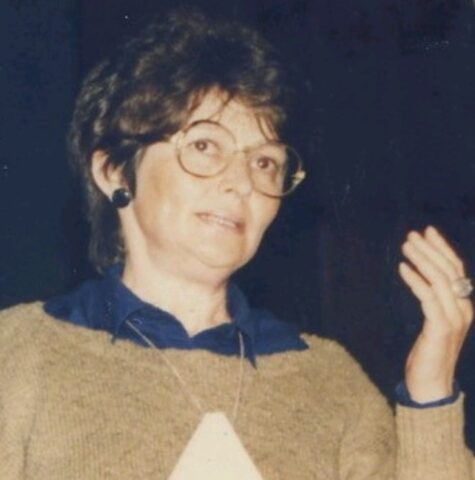
Photo courtesy of the Mirković family
The Author
The Translator
Translation copyright © John K. Cox 2026.
This excerpt was first published in 2004 in Serbian, in the novel Kraj puta: završetak romana Put u Birobidžan [The End of the Road: The Conclusion of the Novel “The Road to Birobidzhan”].