

Messiah, Son of David / Face
Published in Issue #42The day the messiah arrived was business as usual. The Jerusalem hospital where I worked as a psychiatrist admitted more messiahs in a week than most psychiatric hospitals admitted in a year. At any given time, four or five preached and prayed on the wards.
The police told me that this messiah had been picked up en route to the Western Wall Plaza on a donkey. He’d come peacefully, albeit dejectedly, repeating that he was the descendant of the great King David and had come to usher in the redemption. It was nothing I hadn’t heard before.
The messiah and I sat at a battered metal table in a windowless intake room. The walls were grey and pockmarked, and a mold spot bloomed on the ceiling. After forty years of practice, I felt a similar state of ruin—haunted by the patients I’d relegated to locked wards, the drug regimens I’d prescribed to pacify them, all at a terrible cost. Their wild and forlorn faces flared before me.
The man before me looked to be around sixty. He was wiry with wispy grey-brown hair and a pointed beard in the style of Ted Neeley’s in Jesus Christ Superstar. He wore a long brown tunic with bell-shaped arms and simple desert sandals. When I pulled my chair towards his, he moved his away.
“What’s your name?” I asked.
“Messiah, son of David,” he said, looking at the floor.
He seemed humbler than most messiahs. The last one I’d admitted stood on his chair and pounded his fists in the air like a boxer, proclaiming that he would rebuild the Holy Temple and ingather the exiles from the corners of the earth.
“Do you have any identification?”
“I will be identified by the People of Israel.” He placed his hands on the table. His nails were clean and manicured.
When I asked about medications and previous hospitalizations, he shrugged. Messiahs were notoriously unhelpful when it came to worldly matters.
“How did you get here?” I asked.
“Donkey.”
“Did someone send you?”
“The Holy One, Blessed Be He.” His tone was matter-of-fact.
I sighed. It was an old story, and my patience had worn thin. At the same time, I noticed that this messiah did not have the telltale signs of someone treated long-term for psychosis: the hunched posture, expressionless face, institutional pallor. Had he never received treatment? Was the onset of his disorder recent?
When I asked him the purpose of his visit, he quoted from Isaiah, Jeremiah, and Ezekiel. He said he had not come to perform signs or wonders, but to usher in an era of peace and rejoicing.
Peace and rejoicing. In a few short years, I’d weathered the deaths of both my parents and a rancorous divorce. I’d buried myself in work, but what difference was I making in this dank room that smelled of mold and old coffee grounds?
I needed a savior, but not this ersatz Jesus. He was just one more in the stream of false messiahs throughout Jewish history—Bar Kochba, David Alroy, Shabtai Tzvi—who’d arrived at opportune, desperate times, wreaking destruction on the very people they’d come to redeem. And, or, he was psychotic. I’d admitted dozens of them; they’d met the DSM criteria and had been a danger to themselves or to others.
And yet, something about this messiah felt different.
Belief in the messiah is one of Judaism’s thirteen core principles of faith—and not the only one I could be accused of violating. But what if, in my faithlessness, I’d overlooked the real messiah? Or worse, consigned him to a locked ward? What if this man were the real messiah? No, I didn’t believe he was the messiah; I didn’t believe in any messiah.
But I wished I did.
Tears broke in my eyes. I looked down at my lap to hide my emotion, but it was not lost on the messiah.
“Did you await my arrival every day?” he asked, leaning in. “Did you believe with a perfect faith?”
I shook my head.
“Well then,” he said. His shoulders crumpled.
We sat in sad silence. The sounds of rushed footsteps and people moaning filtered through the walls. I imagined the messiah and me as old friends looking for one another on the wrong street corners.
A part of me wanted to hold him captive in the crumbling room, but I stood and opened the door a crack. When the traffic in the hall cleared, I indicated to him that he was free to go. He cupped his hands and bowed low.
“Take care,” I said. “I hope to see you again in different circumstances.” It was my best approximation of I’ll await your arrival every day. He thanked me, then walked collectedly out the door.
I sat down at the table. The room felt dismal without him. Even the mold spot seemed to have made inroads across the ceiling. I shuddered from the dampness—or was it dread that I’d made the worst professional judgment of my career?
*
Several months later, I retired and didn’t expect to meet any more messiahs. But every few months, I’d see someone who bore an uncanny resemblance to the last messiah I’d met. I didn’t approach him. After all, we’d been waiting for 2600 years—what were the chances? And if he were the messiah, would redemption not, by definition, be upon us? Sadly, I saw no sign of it. Unless my own desperate longing was just that: a sign.
Still, seeing him gave me hope, and hope made the days easier to bear. The messiah was out there—changing a flat tire, weeding a garden, selling strawberries by the side of the road. Redemption was a street corner away.
Face
God showed up in shul today, slipped into the aisle seat of the third to last row of the men’s section and opened a prayer book. I don’t know how I knew it was God. There was nothing exalted about him.
My first thought was, What’s he doing here? I mean, isn’t he already here? Then, disappointment: an old man? I blamed the tethers of my imagination, and a liturgical lifetime of king and father metaphors.
He stood about five foot six with a stocky build. I couldn’t see his face; it was covered with a prayer shawl, which made sense. Surely I will hide my face . . . His pants must have been falling down, judging from the way they bunched at his calves. All in all, he did not inspire confidence.
The men sitting around him did not seem to notice that God was in their midst, despite their rocking furiously and moving their lips in supplication. I watched from my balcony seat in the women’s section, where I should have been praying—God knows I have enough to entreat Him for.
At the front of the synagogue, two tablets inscribed with the Ten Commandments proclaimed: I am God. You shall not . . . Above the Holy Ark, gold letters gleamed: Know before whom you stand. All around me women swayed, faces contorted in petition and contrition.
I was yawning, picking lint off my skirt, flipping the pages to see how many more outpourings of praise I had to endure. Then, there was God—incognito, as usual.
Not that I blamed him. I’d hide too if I were in charge of a world in such disarray. Duck down, shamefaced like that adulterous couple caught on the jumbotron at the Coldplay concert.
You’d think a God of Miracles could keep things running more smoothly. If you believe the stories—parting the Red Sea, making the sun stand still, toppling the walls of Jericho, all that razzle-dazzle—you’d ask, wouldn’t you: Would it have been so much skin off your nose to save the victims of October 7th?
The problem is, I’ve studied enough Bible to know that when Job called God to account for human suffering, he got blasted. “Where were you when I laid the earth’s foundations?” God roared. He had a point. Still, as Ivan Karamazov noted, how many times can you be asked to submit to a grand plan you don’t understand, one predicated on so much undeserved suffering, before you question the plan—before you, as he said, “respectfully return Him the ticket”?
Brazen as I knew it would be to storm downstairs and confront God, it felt worse to stay in my seat. And if we were supposed to be holding some version of this conversation through the prayers, well, they weren’t working for me.
I closed my prayer book, stomped downstairs, pushed open the swinging doors to the men’s section, and marched inside. “God,” I said, “God!” By now I was fuming. My breath was labored, my fists clenched. I must have looked a fright because the men peered at me anxiously from under their prayer shawls. One approached like he was going to strong-arm me out of the sanctuary.
I strode right up to God. “Excuse me,” I said, because I had no idea which honorific to use: Almighty, Creator, Sir. But also because I couldn’t think straight. What on earth was I planning to say? What the f–! came to mind but even I wasn’t that deranged.
Instead, I said, “Help.”
God turned towards me and folded back the edge of his prayer shawl.
I took a step back.
His face.
His face.
It was the saddest thing I’d ever seen. Lines so deep, they looked like rivulets of tears carved over millions of years. And his eyes a pale, emptied-out blue.
Dizzy, I grabbed the back of a pew. Before I could gather my wits about me, murmured voices closed in. “Get her out of here!” someone shouted.
With no time for a bow or an à bientôt to God, I fled out of the sanctuary, through the lobby, down the front stairs of the building, and into the tree-rimmed courtyard, where I sat down on a bench under a carob tree. Not a moment later, the door to the synagogue swung open and God exited, heading my way.
“You almost caused a riot in there,” he said, dropping down next to me.
“I know.”
“Did you . . . Was there something . . . ?” The sunlight smoothed the fissures in his face, and he looked slightly less anguished.
I bit my lip, swallowed a sob, but my mouth pulled open in an involuntary o and I yowled, “Why didn’t you do anything? You’re God, for God’s sake, you could have saved them.” My breaths came fast and hard.
He looked at me with that stricken face.
That’s when it came to me, plain as day: he couldn’t have.
I imagined, looking across the courtyard, my puny, futile “why” joining a growing gathering of woebegone whys, that en masse, slinked away.
“Whatever,” I said. “It’s okay. You’ve got a lot on your plate.”
Prayer soared through the synagogue windows, “Magnified and sanctified be thy holy name . . . ” God edged toward me on the bench, took my hand in his, lifted it as if it were a small, fragile object, and pressed it to his cheek.
Then he was gone.
A flock of starlings descended on the carob tree, wings beating in a unified hum. Congregants filed out of the building and dispersed. Last to leave, the shamash locked the front door. I sat on the bench for what seemed like an eternity, holding God’s hand in mine.
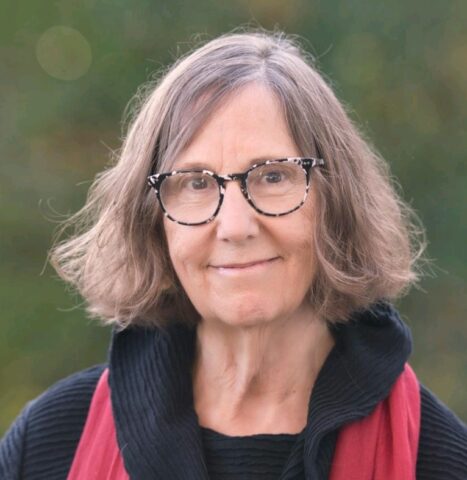
The Author
Copyright © Miriam Mandel Levi 2026